

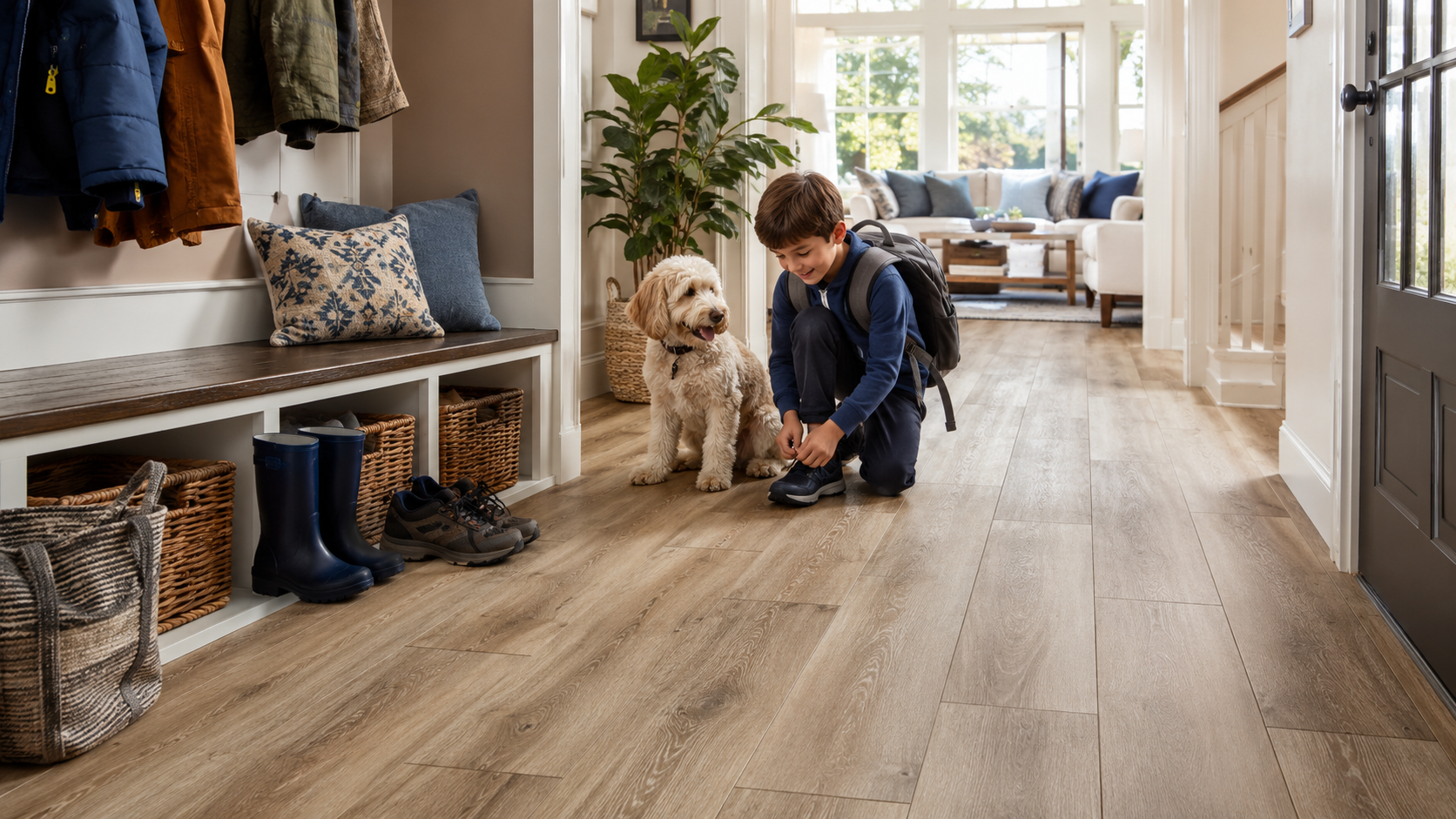
Kids, dogs, dragged-out chair legs, and toys scattered across the living room floor: if that sounds like a typical afternoon in your Apple Valley home, flooring durability probably ranks near the top of your renovation checklist. Luxury vinyl has become the go-to choice for exactly this kind of household, but not all vinyl flooring performs the same way once real life starts happening on top of it.
At Galaxie Floor Stores, we've spent more than 70 years helping Minneapolis area families choose flooring that can actually keep up with them, so we wanted to break down what genuinely makes vinyl scratch-resistant, and how to shop for it with confidence.
What Actually Makes Vinyl Scratch-Resistant
The part of a vinyl plank that determines scratch resistance is called the wear layer, a clear protective coating fused to the top of the plank. It's the only part of the floor that directly resists scratches, scuffs, and daily abrasion from claws, chair legs, and dragged furniture. Underneath the wear layer sits the printed design layer, and beneath that, the structural core that gives the plank its stability.
Wear layer thickness is measured in mils, where one mil equals one-thousandth of an inch. It sounds like a small number, but it's the single most important spec to check when comparing vinyl flooring for an active household, more important than price or even brand name.
How Much Wear Layer Do You Actually Need?
Wear layers generally fall into three tiers, and matching the right one to your household makes a real difference in how the floor looks five or ten years from now.
6 mil is the entry point for residential vinyl. It's fine for light-traffic spaces like guest rooms or closets, but it tends to show wear patterns within two to three years in a busy household, and it's not a good match for homes with dogs or young kids.
12 mil is the sweet spot for most family homes. It resists everyday scratches from pet claws, chair legs, and tracked-in debris, and typically holds up well for seven to ten years of daily family life. This is the range we recommend most often for Apple Valley households with moderate pet and kid activity.
20 mil is considered commercial-grade protection, and it's worth the upgrade for homes with large or multiple dogs, high foot traffic areas like entryways and mudrooms, or families who simply want the longest possible lifespan before the floor needs replacing.
Rigid Core Technology: Why It Matters for Durability
Most modern luxury vinyl plank uses a rigid core construction, built from either stone polymer composite (SPC) or wood polymer composite (WPC), rather than the older, more flexible vinyl of a decade ago. Rigid core flooring resists denting and impact far better than traditional flexible vinyl, which matters when a heavy toy box gets dropped or a dining chair scrapes across the floor.
SPC cores are denser and more rigid, making them a strong choice for high-traffic areas and homes with heavier furniture or larger dogs. WPC cores are slightly softer underfoot and offer a bit more comfort and warmth, which some families prefer in bedrooms or living areas where people spend more time standing or sitting on the floor. Both constructions are fully waterproof, so the choice mostly comes down to comfort versus maximum rigidity for your specific rooms.
Choosing the Right Finish and Texture
Beyond the wear layer itself, the surface finish plays a real role in how well a floor hides everyday wear between deep cleans. Matte and low-sheen finishes are increasingly the standard choice, not just for style but because they show scratches, scuffs, and pet hair far less than a glossy finish. Textured, embossed surfaces that mimic real wood grain add a further layer of camouflage, since the texture itself helps disguise minor marks.
Some manufacturers now infuse their urethane wear layer with tiny ceramic beads, which adds extra toughness and scratch resistance while also giving the surface a bit more grip and texture underfoot. It's a detail worth asking about if you're comparing similarly priced planks and want to know what's actually different beneath the surface. Our Vinyl Flooring selection includes a range of wear layers, cores, and finishes side by side, so you can compare samples in person before deciding what fits your household.
Vinyl vs. Hardwood, Laminate, and Carpet for Active Households
It's worth understanding how vinyl actually compares to the other flooring options you're likely weighing, since each handles active family life differently.
Hardwood is beautiful but genuinely vulnerable to scratches from claws and dropped toys, and refinishing it to remove deep scratches is a costly, disruptive project. It's also not waterproof, which rules it out for basements or anywhere spills are frequent.
Laminate offers a similar wood-look aesthetic at a lower price point, but its wear layer is generally thinner than a quality vinyl plank, and standard laminate isn't waterproof, meaning a swollen, damaged core is a real risk after a pet accident or a leaking dishwasher.
Carpet is comfortable underfoot but holds onto pet hair, dander, and odours in a way hard flooring simply doesn't, and it shows wear paths and stains far more visibly over time in high-traffic family areas.
Vinyl, particularly a rigid-core plank with a 12 to 20 mil wear layer, is the only option among these that combines genuine scratch resistance, full waterproofing, and a soft, warmer underfoot feel than tile or stone, which is exactly why it has become the default recommendation for households with both kids and pets.
Waterproof and Scratch-Resistant: Why Both Matter Together
Scratch resistance solves half the problem for an active household, but water resistance solves the other half. Quality rigid-core luxury vinyl is waterproof from top to bottom, which matters just as much as the wear layer when you're dealing with muddy paws, spilled water bowls, or the occasional pet accident. A floor that resists scratches but swells or warps at the first spill isn't actually built for family life.
Together, a 12 to 20 mil wear layer and a fully waterproof rigid core cover the two biggest stress points in an active Apple Valley household: the physical wear from claws and chair legs, and the moisture that comes with kids and pets sharing the same space every day.
Built for Minnesota's Seasons, Not Just Busy Households
Minnesota's mix of humid summers and dry, heated winters puts real demands on flooring, particularly in basements, mudrooms, and entryways where moisture and temperature swings are most pronounced. A properly installed rigid-core vinyl floor handles these seasonal shifts without the warping or gapping that can affect other flooring types, which makes it a particularly practical choice for Apple Valley homes with finished basements or busy mudroom entries used year-round.
Maintenance Tips That Keep Scratch-Resistant Vinyl Looking New
Even the toughest wear layer benefits from a bit of routine care. A few habits go a long way toward preserving that finish for the long term:
Vacuum or sweep regularly, using a vacuum without a beater bar, which can be harsh on the surface over time.
Damp-mop with a cleaner formulated specifically for vinyl flooring, and avoid oil-based or wax products, which can dull the finish rather than protect it.
Use felt pads under furniture legs, and avoid rubber-backed mats, which can occasionally react with vinyl finishes over long periods of contact.
Trim pet nails regularly, since even a high mil wear layer performs best when it isn't facing sharp, overgrown claws daily.
What to Check Before You Buy
With so many vinyl options on the market, it helps to know exactly which specs to ask about when you're comparing products, rather than relying on marketing terms like "durable" or "family-friendly," which don't have a standard definition. A few concrete questions to bring to your showroom visit:
What's the wear layer thickness, in mils? This is the single biggest factor in scratch resistance, and it should be listed clearly on any quality product.
Is the core SPC or WPC, and is it fully waterproof? Confirm waterproofing applies to the whole plank, not just a surface-level water-resistant coating.
What finish is used on the wear layer? Standard urethane, ceramic bead-infused, or another proprietary coating can all perform differently in terms of both scratch resistance and grip.
What's the manufacturer's warranty, and does it cover residential pet and family use specifically? Warranty terms often reveal how confident a manufacturer actually is in a product's real-world durability.
Bringing this short list to your appointment makes it far easier to compare products on substance rather than price or packaging alone.
Why Local Installation Matters for Apple Valley Homes
Even the best-rated vinyl flooring depends heavily on correct installation. Subfloor preparation, acclimation time before laying planks, and proper expansion gaps around the room's perimeter all affect how well a floor performs over its lifetime, particularly through Minnesota's seasonal humidity and temperature changes.
Galaxie Floor Stores has served Minneapolis area families since 1955, and our certified, bonded, and insured installer team brings that experience to every vinyl flooring project. As a locally owned business, our owners are in the stores and available if a question comes up, not routed through a distant call centre, which matters when you're trusting a floor to hold up against everyday family life for a decade or more.
Getting an Accurate Quote for Your Flooring
The right wear layer, core type, and finish for your home depends on your specific household, from the number and size of pets to how the space gets used day to day. The most reliable way to land on the right choice is to talk it through with someone who can measure your space and walk you through samples in person.
Galaxie Floor Stores offers a free estimate, including an in-home measurement and consultation, so you can choose flooring with real confidence rather than guessing based on a product label. There's no obligation, and it's the clearest path to a floor that's actually built for your Apple Valley household.
Frequently Asked Questions
Is 12 mil enough for a home with a large dog? For most medium to large dogs, 12 mil is a reasonable minimum, and many households do well with it for seven to ten years. If you have a particularly large or high-energy breed, multiple dogs, or heavy foot traffic through entry points, upgrading to 20 mil offers meaningful extra protection worth the additional cost.
Can scratch-resistant vinyl still get scratched? Yes, no wear layer is completely scratch-proof, particularly against coarse grit tracked in from outside or furniture dragged without protective pads. A thicker wear layer significantly reduces both the frequency and visibility of scratches, and a textured, matte finish helps camouflage the minor marks that do occur.
Does a thicker wear layer mean a thicker, harder-feeling plank overall? Not necessarily. Wear layer thickness and overall plank thickness are two different specs. A plank can have a substantial 8mm total thickness with a thin wear layer, or a slimmer plank with a generous wear layer. It's worth asking about both numbers rather than assuming a thicker plank automatically means better scratch protection.
How soon can pets and kids use the room after installation? Click-lock luxury vinyl flooring is typically walkable almost immediately after installation, since there's no wet adhesive or curing time involved in most residential installations. Your installer can confirm the exact timeline based on the specific product and installation method used in your home.
The Bottom Line
Scratch resistance in vinyl flooring comes down to a handful of concrete specs: wear layer thickness, core construction, and surface finish, not marketing language on the box. For most active Apple Valley families, a 12 to 20 mil wear layer over a rigid SPC or WPC core, finished in a matte or textured surface, delivers a floor that holds up to daily life for years without losing its looks.


