

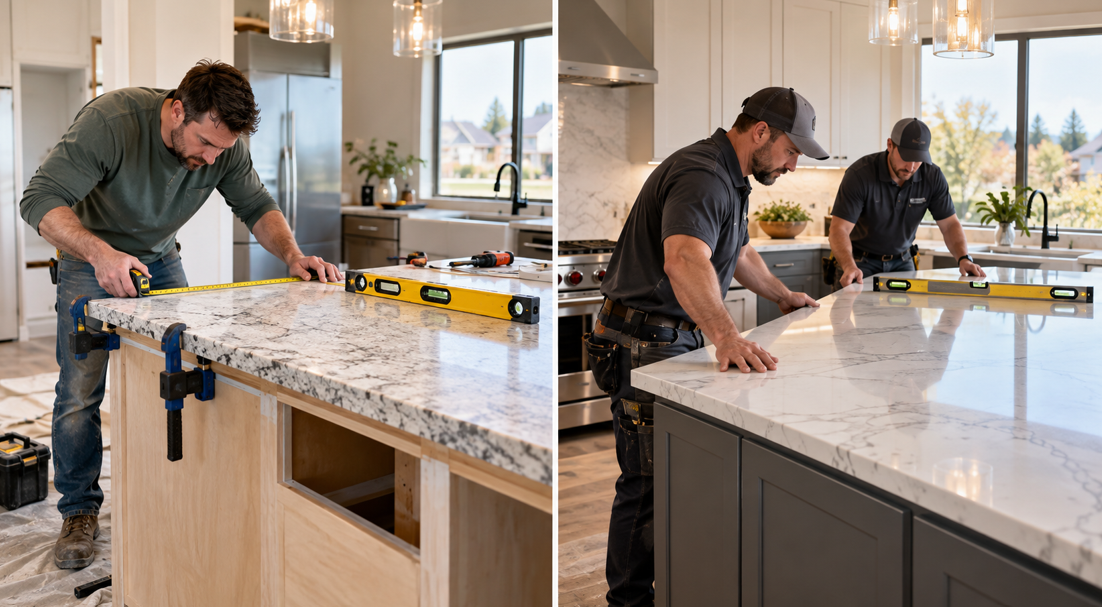
Replacing a countertop can completely change how a kitchen or bathroom looks and functions. A fresh surface can brighten the room, provide more practical workspace, and help tie cabinets, flooring, backsplash, and fixtures together. But once you have chosen a countertop material, another important decision follows: should you install it yourself or hire a professional?
For Apple Valley homeowners, the right answer depends on more than whether you are comfortable using tools. Countertop installation can involve precise measurements, heavy materials, sink and cooktop cut-outs, seams, cabinet preparation, plumbing coordination, and finishing details that affect the appearance and performance of the completed project.
Some smaller or simpler projects can be suitable for an experienced DIYer. Others are much better handled by trained installers, particularly when stone, quartz, complicated layouts, or custom fabrication are involved.
At Galaxie Floor Stores, we have spent more than 70 years helping Minneapolis-area homeowners make practical decisions about kitchens, bathrooms, flooring, cabinetry, and countertops. If you are deciding between DIY and professional countertop installation, understanding what each option actually involves can help you choose the approach that makes sense for your home, budget, and expectations.
Why Countertop Installation Deserves Careful Planning
It is easy to think of countertop installation as simply placing a new surface on top of cabinets. In reality, the finished result depends on several details working together.
Cabinet bases need to provide proper support. Measurements need to account for walls that may not be perfectly square. Sink, faucet, cooktop, and appliance locations must be accurate. Seams need to be positioned and finished carefully. Overhangs, edges, backsplashes, and adjoining surfaces all need to work with the final layout.
Those details are especially important because countertops are one of the most visible and heavily used surfaces in a kitchen.
A small mistake in paint or hardware is usually easy to correct. A measuring or cutting mistake in a countertop can be much more expensive.
Before deciding to tackle the job yourself, consider the complete installation process rather than only the final step of placing the countertop.
When DIY Countertop Installation Can Make Sense
DIY installation is not automatically a bad choice. For the right homeowner and the right project, it can be a reasonable way to reduce labour costs and take a hands-on role in a renovation.
The key is knowing when a project is realistically manageable.
You Have Strong DIY Experience
Someone who regularly handles carpentry, remodelling, plumbing, or similar projects will have a very different experience from someone attempting a major installation for the first time.
Countertop work often requires accurate measuring, levelling, fastening, cutting, sealing, and finishing. If you already understand how cabinets, walls, sinks, appliances, and trim interact, a straightforward installation may be within your skill set.
If your previous DIY experience is limited to painting, replacing hardware, or assembling furniture, a countertop project may be a much bigger jump than it first appears.
The Layout Is Simple
A straight countertop run is generally easier to work with than a kitchen with multiple corners, an island, several seams, unusual angles, or complicated appliance openings.
Every additional corner and cut-out creates another point where accuracy becomes important.
An Apple Valley kitchen with a simple galley layout and an uncomplicated countertop material may be more DIY-friendly than a large open-concept kitchen with an island, undermount sink, cooktop, and several joining sections.
The Material Is Manageable
Material choice has a major influence on whether DIY installation is practical.
Some laminate countertop systems and certain pre-cut or prefabricated products can be more approachable for homeowners with the right equipment and experience. Large slabs of quartz, granite, or other stone products are another matter.
These materials can be extremely heavy and difficult to manoeuvre safely. They may also require specialised fabrication equipment for polished edges, seams, sink openings, and other custom details.
The cost of damaging a slab can quickly exceed the labour savings that made DIY installation attractive in the first place.
You Have Enough Time
DIY work often takes longer than expected.
A professional crew performs countertop installations regularly. A homeowner may need additional time to research each step, purchase tools and supplies, correct unexpected issues, and coordinate plumbing or appliance work.
If the kitchen needs to return to service quickly, that difference can matter.
The Potential Advantages of DIY Installation
For homeowners who are genuinely prepared for the work, DIY countertop installation can offer several advantages.
The most obvious is potential labour savings. If you already own the required equipment and are installing a relatively simple product, doing the work yourself may reduce part of the overall project cost.
DIY also gives you complete control over timing. You can remove the old surface, make cabinet adjustments, and complete finishing work according to your own schedule.
Some homeowners simply enjoy doing renovation work themselves. Successfully completing a kitchen project can be satisfying, especially when you already have the necessary skills.
However, these benefits need to be considered against the financial and practical risks.
Saving on installation does not necessarily mean saving on the overall project if a mistake requires replacement material, additional fabrication, or professional correction later.
Common Challenges With DIY Countertop Installation
Before choosing DIY, it helps to understand where countertop projects commonly become complicated.
Measurement Errors
Countertop measurements need to be precise.
Walls in existing homes are not always perfectly straight or square, and even small differences can affect the fit. Corners, cabinet runs, finished panels, appliance openings, and overhangs all need to be considered.
There is also little room for guesswork when a countertop has already been fabricated.
A measurement that is slightly wrong can create an obvious gap, an uneven overhang, or a section that simply will not fit into position.
Heavy Materials
Weight is one of the most underestimated parts of countertop installation.
Large countertop sections can be awkward to move through doors and hallways and difficult to position on cabinetry without damaging walls, cabinets, floors, or the countertop itself.
Stone and engineered slab products can also be vulnerable to cracking if they are lifted or supported incorrectly.
Professional installation teams are accustomed to handling these materials and planning how they will move each piece safely into the room.
Sink and Cooktop Cut-Outs
Cut-outs add another level of complexity.
The opening must match the fixture while maintaining sufficient countertop material around it for strength and support. Undermount sinks also require careful positioning and attachment because the edge of the opening remains visible.
A cooktop opening has similar dimensional requirements.
Mistakes in either location can be difficult or impossible to disguise.
Seams
Many kitchens require more than one countertop section.
The location and finish of the seam can have a substantial effect on the final appearance. Pieces need to align properly in height and pattern while the joint is secured and finished.
Depending on the countertop material, achieving a clean seam may require tools, adhesives, or techniques that an occasional DIYer does not normally use.
Cabinet Preparation
New countertops depend on what is underneath them.
Cabinets need to be secure and properly positioned before installation begins. If base cabinets are uneven, the countertop can sit incorrectly or experience unnecessary stress.
Older kitchens may reveal issues only after the existing countertops are removed.
That is one reason countertop replacement should be planned as part of the complete kitchen rather than treated as an isolated surface change.
What Professional Countertop Installation Includes
Hiring an installer is not simply paying someone else to lift the material.
Professional installation brings experience to several stages of the project, including measurement, planning, fabrication coordination, placement, levelling, seam work, and finishing.
When selecting new countertops, it is worth thinking about installation at the same time as material, colour, edge profile, and backsplash design.
A professional can identify practical issues that may not be obvious when viewing a countertop sample in a showroom.
For example, the layout may influence where seams should go. The location of an undermount sink may affect fabrication. An existing cabinet run may require adjustment before the new surface is installed. A countertop overhang may need appropriate support.
Addressing these details before installation can make the project considerably smoother.
The Benefits of Professional Installation
Accurate Measuring and Planning
Professional measuring reduces uncertainty before material is cut or fabricated.
Installers understand how to account for walls, cabinet dimensions, corners, appliances, overhangs, and other conditions that influence the finished fit.
Accuracy is particularly valuable when working with custom countertop materials where fabrication decisions are made before the surface arrives at the home.
Experience With Difficult Materials
Materials such as quartz and natural stone require careful handling.
Professional installers work with large countertop sections regularly and understand how to transport, position, support, and secure them while reducing the risk of damage.
This experience becomes especially valuable in kitchens with islands, narrow access points, stairs, unusual layouts, or large slabs.
Cleaner Details
Much of the perceived quality of a countertop installation comes from small details.
Consistent overhangs, carefully finished seams, well-positioned sink openings, clean edges, and accurate transitions all contribute to a polished result.
These details may not be the first things you notice in a completed kitchen, but poor workmanship can make them very noticeable.
Better Project Coordination
Kitchen projects often involve more than one trade or product category.
Countertop installation may need to be coordinated with cabinets, plumbing, backsplash installation, flooring, appliances, and electrical work.
Working with professionals can make it easier to understand which steps need to happen first and what needs to be ready before the countertop arrives.
For quality-conscious homeowners throughout the Minneapolis metro, that coordination can be just as valuable as the physical installation itself.
DIY vs. Professional Installation: Questions to Ask Yourself
There is no single answer for every Apple Valley homeowner. Instead, consider the following questions before making a decision.
What Material Am I Installing?
A relatively simple laminate project is very different from installing a large quartz or natural stone surface.
The heavier, more expensive, and more customised the material, the stronger the case for professional installation becomes.
How Complicated Is My Kitchen Layout?
Count the corners, seams, cut-outs, appliance openings, and separate countertop sections.
If your kitchen has an island, angled walls, a peninsula, an undermount sink, or unusual dimensions, professional experience may help avoid expensive errors.
Do I Have the Right Equipment?
Owning a circular saw does not necessarily mean you have everything needed for countertop fabrication and installation.
Depending on the material, the project may require specialist cutting equipment, clamps, levelling tools, adhesives, support systems, finishing materials, and safe methods for moving large pieces.
Buying or hiring equipment reduces some of the cost advantage of DIY.
What Happens if I Make a Mistake?
This is one of the most important questions.
Consider the replacement cost of the countertop material, not just the amount you could save on labour.
If a cutting or measurement error ruins a section, the financial impact may be substantial.
How Important Is the Finished Appearance?
DIY does not automatically mean poor results. Experienced homeowners can produce excellent work.
But if you expect precise seams, detailed edges, a professionally mounted sink, and a carefully finished result, compare those expectations honestly with your own experience.
Do Not Forget the Cabinets Beneath the Countertop
If you are replacing countertops as part of a larger Apple Valley kitchen renovation, evaluate the cabinets before ordering the new surface.
Installing an expensive new countertop over cabinets that you intend to replace shortly afterwards is rarely ideal.
Check whether the current cabinet layout works, whether the boxes are structurally sound, and whether you want to make changes to the island, sink position, appliances, or storage configuration.
Countertops and cabinets are closely connected. Making those decisions together helps avoid paying twice for work that could have been coordinated from the beginning.
The same principle applies to backsplashes. If both surfaces are being replaced, choose materials together so that colours, patterns, and undertones complement one another.
Consider the True Cost, Not Just the Installation Quote
DIY often looks less expensive when you compare only labour costs.
A more useful comparison includes all project expenses.
For DIY, that could include tool purchases or hire, adhesives, fasteners, transportation, waste from mistakes, extra materials, help moving heavy sections, disposal of the old countertop, and your own time.
Professional installation has an upfront labour cost, but some of those responsibilities are transferred to people who perform the work regularly.
Your decision should therefore be based on overall value rather than simply asking which option has the lowest initial price.
For many homeowners, peace of mind and confidence in the finished result are part of that value.
When Professional Installation Is Usually the Better Choice
Professional installation is worth serious consideration when your project includes custom-fabricated surfaces, quartz or natural stone slabs, undermount sinks, multiple seams, complicated angles, islands, cooktops, or significant cabinet adjustments.
It can also be the better choice when you simply do not want your kitchen renovation to become a lengthy weekend project.
Home improvement decisions should fit your lifestyle as well as your budget.
Some Apple Valley homeowners enjoy managing every part of a renovation themselves. Others would rather spend their time selecting materials and design details while trained installers handle the technical work.
Neither approach is automatically right in every situation.
What matters is matching the installation method to the complexity and value of the project.
Plan Your Countertop Project With the Finished Kitchen in Mind
The best countertop projects begin with more than a material sample.
Consider how the countertop will interact with your cabinet colour, flooring, backsplash, wall colour, lighting, appliances, and everyday routines. Think about where you prepare meals, where small appliances live, how much maintenance you are comfortable with, and how you want the room to feel.
Seeing materials together can make those decisions easier.
Galaxie Floor Stores serves homeowners from its Apple Valley and Bloomington showrooms with a locally owned approach built through more than 70 years of experience. Along with countertop selection, the team can help homeowners think through cabinetry, flooring, measurements, design coordination, and professional installation.
That broader perspective is especially useful when the countertop is one part of a larger kitchen update rather than a stand-alone replacement.
DIY or Professional? Choose Based on the Project
DIY countertop installation can make sense for a capable homeowner tackling a simple, manageable project with an appropriate material. It can reduce labour expenses and provide the satisfaction of completing part of the renovation yourself.
Professional installation becomes increasingly valuable as materials become heavier, layouts become more complicated, and fabrication becomes more precise.
Before deciding, weigh the cost savings against the material value, difficulty of the layout, equipment required, time involved, and consequences of an installation mistake.
A countertop is something you will see and use every day. Taking time to plan both the material and the installation method can help ensure the finished kitchen looks good, functions well, and supports the investment you are making in your home.
If you are planning a countertop update in Apple Valley and want help comparing options, measurements, and professional installation, request a free estimate to start a conversation with the Galaxie Floor Stores team.